

|
|
|
|
Announcement (July 1999) of the discovery of the (then) largest known composite Fermat number:
My Maple-based public lecture - The history of Fermat numbers from August 1640 - may be accessed in the Public and other lectures section of my site. A related paper, written by Yves Gallot, may be accessed here
The above number was found, and proved composite, using Yves Gallot's remarkable
Proth program.
The discovery was made on one of my College's 350 MHz Pentium computers, as a result of finding the prime number
p = 3 times 2382449 + 1. That prime number (at that time the 10th largest known prime, having 115,130 digits) was found at about 5.00 P.M on Friday 23rd July 1999, and the extra day-long computation then established that it is a factor of F382,447.
The previous record composite Fermat number:
was announced by Jeffrey Young in
Mathematics of Computation - an
American Mathematical Society journal - in early 1998.
Jeffrey Young found that F303,088 - having just over 1090,000 decimal digits - has the 91,241 decimal digits prime factor 3*2303,093 + 1.
The new record composite Fermat number - F382,447 - is almost
1024000
times greater than F303,088.
The above Gallot-Proth discovery is the fruit of an international collaborative effort led by
Yves Gallot
- the brilliant creator of the Proth.exe program - ably helped, in the compilation of the work, by the valiant Ray Ballinger.
I was fortunate to be on friendly terms with Richard and wrote to ask if he would come to Dublin to talk about this providing I could get some funding from a USA source, ideally his country's Embassy here in Dublin... . Yes, Richard was willing, and I tried, and I tried, ... , but the USA Embassy wouldn't put up a cent... . I tried putting pressure by mentioning the enlightened French Embassy, but to no avail... ) An informal history of the discovery. For some weeks I had been checking for primality numbers of the form 3*2 n + 1 with n in the range 366,000 to 390,000. Then, just before 5.00 P.M. on the afternoon of Friday, 23rd July 1999, I left my office to check on the state of the Gallot-Proth computations in College's main computer lab., Room D 318. I refreshed the screens of computer after computer, and clicked up the screens to view earlier computations.
In the third row, I examined computer #17, the second last one in that row. After a few seconds I registered - with great delight - that the number 3 times 2382449 + 1 was a prime (and had only been registered as such some minutes earlier). I saw that there was a consequent computation in progress - the one that would test for possible division into related Fermat numbers - which was going to take some "1200mn 27sec" to complete. Thus the outcome would be known at about 5.00 P.M. the following day, the 28th wedding anniversary of myself and my wife, Mary.
I went downstairs to tell my wife that we had almost certainly found the largest composite Fermat number, otherwise Yves Gallot's letter simply would not be sensible... After lunch, and setting off for an afternoon's walk to Dalkey, I began to give my wife yet another lecture on the beauty of Fermat numbers, and - possibly to shut me up, though actually because - as she said - I would get no sleep that night, she suggested we go back home, get our bikes, and cycle over to College...
On the way I could think of nothing else but my boyhood mathematical heroes Euler (who was the first to find a composite Fermat number, the hand sized F5
=
2(25) + 1 = 232 + 1 = 641 times 6700417)
and Fermat.
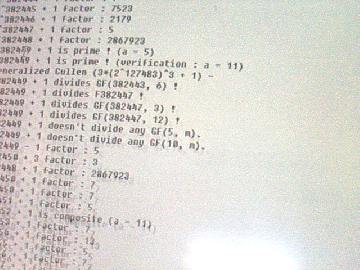
F6 = 2(26) + 1 = 264 + 1 = 274177 times 67280421310721) By the time we got up to Room D 318 I was in quite a state (only some hours later there was a power failure in College; if that had happened before we had arrived...). To computer #17, a touch to the mouse to refresh the screen, a couple of clicks up the side to get back to the earlier outputs, and there it was!! What I learned from correspondence with Yves Gallot. Yves Gallot was about to leave his office in Toulouse that Friday afternoon when he checked at Chris Caldwell's site to see which new large primes had been submitted that day, and he saw the one I had submitted a few hours earlier. On his arrival home he also saw my e-mail, and immediately set about checking the computations on his own computer. By mid-morning, Sunday 25th he knew that his program had discovered the largest known composite Fermat number... . What joy. After recovering a little, he emailed me, suggesting that I have a look at my College computer... Digital photograph of the screen of computer #17 College suffered a power failure sometime in the evening of Sunday 25th of July, as a result of which the full screen version of the Gallot-Proth computation was lost. However, in Notepad, the entire log of the computations was saved, and today my ever-helpful colleague Paul Murphy took a number of digital photos of the screen of computer #17 (appropriately '17' is a Fermat number!!). Unfortunately you cannot see the initial part of the 3 times 2382449 + 1, but one can see most of the relevant outputs. One can see the important 'a = 5' and 'a = 11,' and the 'F382447.' How large is the number F382,447? I was asked that question many, many times in the days following the discovery. My initial response was something along the lines of: Oh! It is utterly gigantic, astronomically large, etc., etc. Then I decided to stop giving vague answers, and give a fairly detailed response (which may not be all that more helpful), and it is this:
I prepared a Maple worksheet (HOW_MANY.mws) in which I established these entirely elementary computations, and a text-only html version is available here. (Any reader who has Maple will be able to create their own active worksheet by simply copying and pasting my elementary procedures into it and execute their own computations.) Actually a simple hand-performed calculation (below) will establish the above orders of magnitudes. The above numbers might appear to be a bit fantastic (in the sense of being in the realms of fantasy), but they are not, and I would like to treat the first of them with a back-of-an-envelope analysis, which easily establishes the order of magnitude for the number of digits in the base 10 representation of the Fermat number F382,447 . This is how it can be done (a series of simple lower estimates, which is deliberately pitched at school level), merely by using the simple observation that 210 = 1024 > 1000 = 103. My reader should be able to see the appropriate justification at each stage (read left to right along each line, and then continue into the next line. The expressions have had to be created as gif files, and so some look a little unusual, but should not cause any real difficulties. In the 5th of the expressions, the ' . ' (between the '12' and the '2') is ' times ', and not a ' decimal point '):  >  =  > 
=
and thus:
>
 ... (i) Then, since 2382,445 = (210)38,244.5 > (103)38,244.5 = 10114,733.5 , we finally have, from (i), that
>
>
 and so it is immediately clear that F382,447 has at least 10114,733 digits when expressed in the base 10. Footnote of 28th August 2026. I consulted Wilfrid Keller's Prime factors of Fermat numbers page, and seeing there that the currently largest known composite Fermat number is F18,233,954, I wondered how large it might be. To that end this is what I did: I opened my 1999 HOW_MANY.html Maple text document (it had been a html conversion from a now inoperable early Maple .mws file), and I copied and pasted my LIGHT_YEARS procedure into a Maple 17 (the latest version that I have) worksheet, then changed '382447' to '18233954'. I then exported the .mw worksheet to a .pdf file, and here it is.
|
|
Contact details. jbcosgrave at gmail.com
|



 >