The alpha question became the alpha conjecture
The alpha question. Let ![q[1]](images/TCD_talk_9th_Feb_2005_146.gif) be a prime (greater than 3, to prevent it from being 3) such that
be a prime (greater than 3, to prevent it from being 3) such that
(the ' -1' case) ![q[2] = `+`(`*`(`^`(2, alpha), `*`(q[1])), `-`(1))](images/TCD_talk_9th_Feb_2005_147.gif) and
and  are both prime, or
(the '+1' case) ![q[2] = `+`(`*`(`^`(2, alpha), `*`(q[1])), 1)](images/TCD_talk_9th_Feb_2005_149.gif) and
and  are both prime
is it then true that  (mod p)?
(Private terminology. I took to calling the other primes 'inexplicable' for the time being. Other later examples, when I extended my searching were: 25117 - 1 = ( ) (3) (7) (13) (23), 60919 - 1 = (2) (3) (11) (13) (71),
92401 - 1 = ( ) (3) (
 ) (7) (11), 115827 - 1 =(
 ) (3) (
 ) (197), etc etc.)
There were two first cases to examine, with unimportant order:  with '+1' or '-1'.
Let's say we begin, as I did, with  and '-1': thus we are trying to find primes { p } made up as follows:
![p = `+`(`*`(2.3, `*`(q[1], `*`(q[2]))), 1)](images/TCD_talk_9th_Feb_2005_159.gif) , where
, where ![q[1], q[2]](images/TCD_talk_9th_Feb_2005_160.gif) are primes with
are primes with ![q[2] = `+`(`*`(2, `*`(q[1])), `-`(1))](images/TCD_talk_9th_Feb_2005_161.gif) , (
, (![`<`(3, q[1])](images/TCD_talk_9th_Feb_2005_162.gif) )
)
and are hoping that such primes satisfy:
 (mod p)
Such p's are like this:
![p = `+`(`*`(2.3, `*`(q[1], `*`(`+`(`*`(2, `*`(q[1])), `-`(1))))), 1)](images/TCD_talk_9th_Feb_2005_164.gif) =
= ![`+`(`*`(12, `*`(`^`(q[1], 2))), `-`(`*`(6, `*`(q[1]))), 1)](images/TCD_talk_9th_Feb_2005_165.gif)
which is, as I observed at the time, a quadratic whose discriminant is 
Here I show  and '-1' for forming some primes { p }.
I abbreviate 'alpha' to 'a' in the following to reduce the program lines in the following, in which:
ithprime(k) is the ithprime, 'k' starting at 3 ("from 3"): 5, 7, 11, 13, 17, ...
So, that produces the candidates for ![q[1]](images/TCD_talk_9th_Feb_2005_168.gif)
isprime(2^a*ithprime(k)+SIGN) produces the candidates 2^a*ithprime(k)+SIGN for ![q[2]](images/TCD_talk_9th_Feb_2005_169.gif)
isprime(2^a*3*ithprime(k)*(2^a*ithprime(k)+SIGN)+1) produces the desired primes { p },
the 2^a*3*ithprime(k)*(2^a*ithprime(k)+SIGN)+1
| > | a := 1: SIGN := -1:
count:= 0: for k from 3 to 100 do if isprime(2^a*ithprime(k)+SIGN) and isprime(2^a*3*ithprime(k)*(2^a*ithprime(k)+SIGN)+1) then count := count+1: q1[count] := ithprime(k): q2[count] := 2^a*q1[count]+SIGN: p[count] := 2^a*3*q1[count]*q2[count]+1: fi od; array([[q[1], q[2], p], seq([q1[k], q2[k], p[k]], k=1..count)]); |
 |
(6.1) |
| > |
At the time at which I tested the above, I had systematically tested for  (mod p), for all primes up to the 30,000th (note to myself: all that is saved in a Maple worksheet that I had called 'Wilson play.mws', the name of which gives an indication of my attitude up until then). The largest such prime p I had found at that stage had been 347821 (an 'inexplicable' prime,
  being
being  *3*5*11*17*31), and thus those three last new primes - 627919, 879667, and 2310019 - in the above table were first tester candidates of my alpha observation... (heart beating...).
Well, I wouldn't be here talking to you if it hadn't turned out that:
| > | p1 := 627919: P[1,3](p1) mod p1; # didn't produce a '1' |
 |
(6.2) |
| > | 1372^3 mod p1; # but its cube did |
 |
(6.3) |
| > | p2 := 879667: P[1,3](p2) mod p2; |
 |
(6.4) |
| > | p3 := 2310019: P[1,3](p3) mod p3; |
 |
(6.5) |
| > |
The reader may imagine how I felt seeing those 1's...
| > | a := 1: SIGN := -1:
count:= 0: for k from 501 to 1000 do if isprime(2^a*ithprime(k)+SIGN) and isprime(2^a*3*ithprime(k)*(2^a*ithprime(k)+SIGN)+1) then count := count+1: q1[count] := ithprime(k): q2[count] := 2^a*q1[count]+SIGN: p[count] := 2^a*3*q1[count]*q2[count]+1: fi od; array([[q[1], q[2], p], seq([q1[k], q2[k], p[k]], k=1..count)]); |
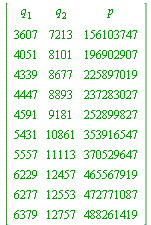 |
(6.6) |
| > |
Here I show  and '+1' for forming some primes { p }:
| > | a := 1: SIGN := +1:
count:= 0: for k from 3 to 100 do if isprime(2^a*ithprime(k)+SIGN) and isprime(2^a*3*ithprime(k)*(2^a*ithprime(k)+SIGN)+1) then count := count+1: q1[count] := ithprime(k): q2[count] := 2^a*q1[count]+SIGN: p[count] := 2^a*3*q1[count]*q2[count]+1: fi od; array([[q[1], q[2], p], seq([q1[k], q2[k], p[k]], k=1..count)]); |
 |
(6.7) |
| > |
I tested alpha up to 10 with both '-1' and '+1' choices, and checked if  (mod p) held, not for all the produced primes { p }, but only because of computation time constraints: for example, the prime 18711862657 (see below:
  ,
, ![q[1] = 617](images/TCD_talk_9th_Feb_2005_183.gif) ,
, ![q[2] = 78977](images/TCD_talk_9th_Feb_2005_184.gif) ) took 80.5 hours to test on a 2.8GHz Pentium 4.
) took 80.5 hours to test on a 2.8GHz Pentium 4.
Here I show  and '+1' for forming some primes { p }:
| > | a := 7: SIGN := +1:
count:= 0: for k from 3 to 200 do if isprime(2^a*ithprime(k)+SIGN) and isprime(2^a*3*ithprime(k)*(2^a*ithprime(k)+SIGN)+1) then count := count+1: q1[count] := ithprime(k): q2[count] := 2^a*q1[count]+SIGN: p[count] := 2^a*3*q1[count]*q2[count]+1: fi od; array([[q[1], q[2], p], seq([q1[k], q2[k], p[k]], k=1..count)]); |
 |
(6.8) |
| > |
Of course I knew I was onto something:
The alpha conjecture. Let ![q[1]](images/TCD_talk_9th_Feb_2005_187.gif) be a prime (greater than 3, to prevent it from being 3) such that
be a prime (greater than 3, to prevent it from being 3) such that
(the ' -1' case) ![q[2] = `+`(`*`(`^`(2, alpha), `*`(q[1])), `-`(1))](images/TCD_talk_9th_Feb_2005_188.gif) and
and ![p = `+`(`*`(2.3, `*`(q[1], `*`(q[2]))), 1)](images/TCD_talk_9th_Feb_2005_189.gif) are both prime, or
are both prime, or
(the '+1' case) ![q[2] = `+`(`*`(`^`(2, alpha), `*`(q[1])), 1)](images/TCD_talk_9th_Feb_2005_190.gif) and
and ![p = `+`(`*`(2.3, `*`(q[1], `*`(q[2]))), 1)](images/TCD_talk_9th_Feb_2005_191.gif) are both prime
are both prime
then  (mod p)
But the problem then became: how can one prove this (almost certainly true) conjecture? That brings me to the next natural section: